
Stringer/REUTERS
- Oil prices surged and stock futures tumbled as traders positioned for the week following strikes on Iran.
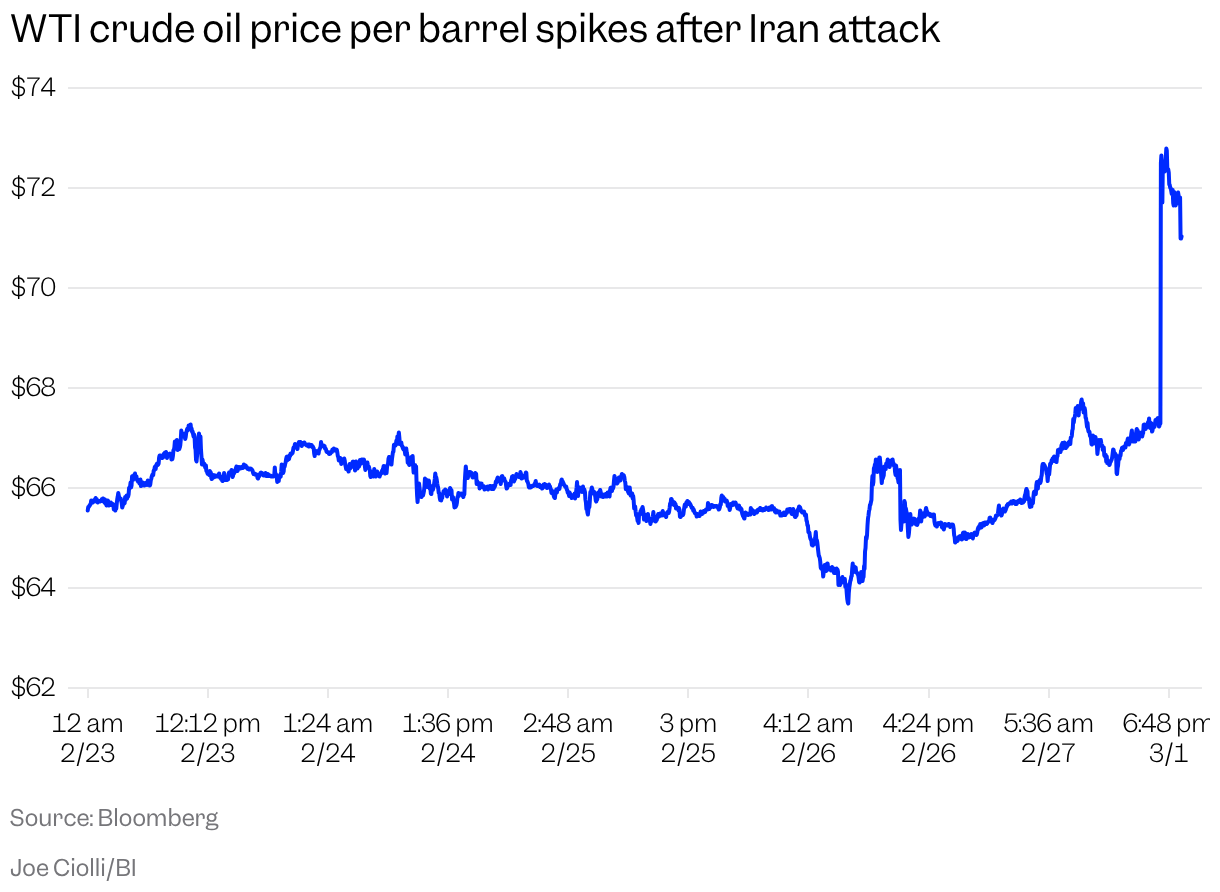
- Brent crude spiked 8% and WTI jumped 7% amid threats to global energy flows.
- Iran attacked ships passing through the Strait of Hormuz on Sunday.
Markets were reeling ahead of the new week, with oil surging and US stock futures tumbling on Sunday evening after the weekend attacks against Iran by the US and Israel.
Here’s a rundown of what major assets are doing:
Oil
Brent oil, the international benchmark, spiked 9% and WTI crude jumped 7% shortly after markets opened. They pared gains to trade 4.7% and 4.2% higher at $76.27 a barrel and $69.82 a barrel, respectively, at 9:11 p.m. ET.
Energy traders are preparing for the possibility that the Strait of Hormuz, a critical shipping route for global energy commodities, is closed for an extended period.
“The immediate price shocks are being accompanied by a fresh wave of supply chain disruptions. This isn’t just a question of whether the Straits of Hormuz are physically closed; the logistical friction is already here,” economist Mohamed El-Erian wrote, pointing to insurance costs, maritime cargo, and aviation as having already been significantly impacted.
Barclays analysts on Saturday described the situation as the “worst fears” for oil, though analysts on Sunday said other energy commodities were also at high risk of repricing.
“Qatar has the world’s third-largest LNG export capacity, and ~20% of global LNG trade transits the Strait of Hormuz (primarily Qatari volumes), which makes shipping risk a gas-market event as much as an oil-market event,” strategists at Franklin Templeton wrote on Sunday.
They described the Strait of Hormuz as “the macro circuit breaker,” and noted that global shipping costs had already risen in the day after the initial attacks.
Higher oil prices risk stoking inflation, and analysts have flagged in the aftermath of other recent conflicts that a sudden spike in energy prices could also tip the global economy into a recession.
Stock futures
Futures on all three main US stock indexes traded were over 0.6% lower as traders assessed the potential for a prolonged conflict. Some noted on Sunday evening that markets currently perceive a low risk that the war drags on for a long time or spills into a wider regional conflict.
“There are additional key market transmission channels to monitor if uncertainty persists,” Adam Hetts, global head of multi-asset at Janus Henderson, said on Sunday. “Broader uncertainty suppresses investor sentiment, which can broadly weigh on risk-assets globally. This would likely make global developed market sovereigns, including U.S. Treasuries, and safe-haven currencies more attractive.”
Hetts added that in a prolonged period of uncertainty, higher oil prices would spark a global inflation scare, which could slash the likelihood of rate cuts by the Federal Reserve this year.
Gold
The precious metal climbed as much as 3.1% to around $5,410 per troy ounce. Geopolitical conflict has been part of the bull case for gold in the last year of its record-setting hot streak, and analysts say a new war in the Middle East could fuel even greater gains.
Bitcoin, meanwhile, tumbled in line with other risk assets like stocks. It traded around $66,239 on Sunday evening, down over 2%.
US dollar
The dollar index, which measures the currency against a basket of major rivals, rose 0.3%.
“The first order reaction to the weekend’s escalation will likely see the dollar benefit on the back of higher energy prices and elevated risk aversion,” Barclays analysts wrote on Saturday after the first attacks.
Risk-off, but no panic selling
In Asia, equities were trading lower on Monday.
Japan’s Nikkei 225 was down as much as 2.7% while Hong Kong’s Hang Seng dipped 2.8%.
Chris Weston, the head of research at Pepperstone, said the overall tone in markets was risk-off. He added that price moves across asset classes remained relatively contained and did not reflect panic-driven selling.
“The cross-asset moves are orderly, and the more outsized volatility appears largely contained to the energy complex,” he wrote.
Within energy markets, Brent crude’s inability to sustain a move above $80 a barrel indicates that traders may have already priced in a meaningful supply disruption, he added.
Higher output quotas from OPEC+ could also be helping to limit further upside in oil prices, he added, referring to the oil-producing group’s plan to boost crude oil output by 206,000 barrels per day from April.